
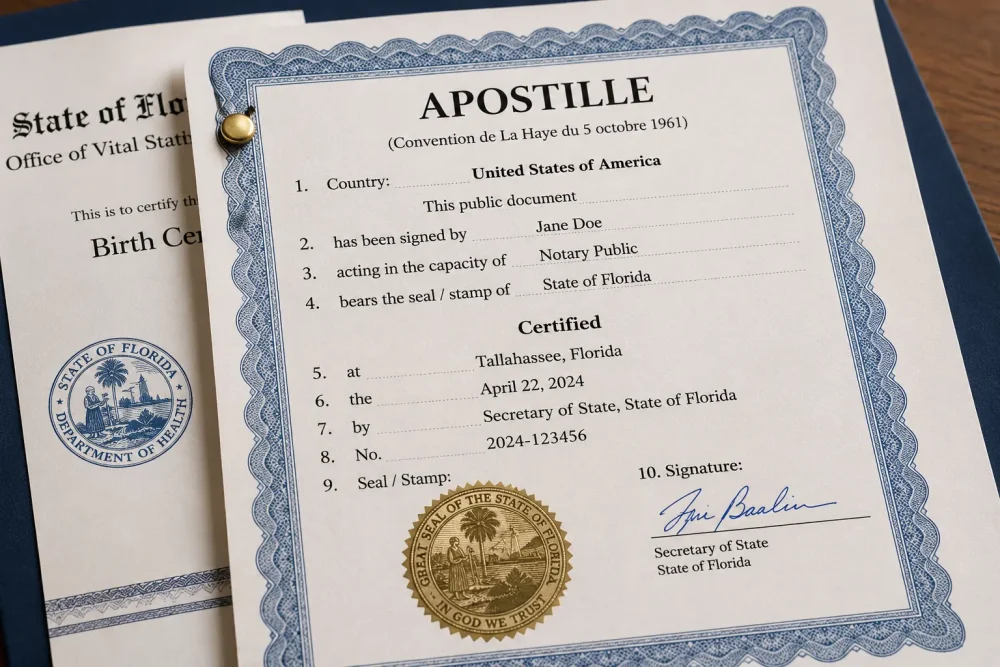
Certified translation before apostille is one of the most common questions people ask when preparing documents for international use. Unfortunately, there isn’t a simple “yes” or “no” answer.
Every week, people spend money on a certified translation only to discover they needed the apostille first. Others complete the apostille process, only to learn that the receiving authority wanted the translation completed beforehand. These misunderstandings can delay visa applications, overseas employment, dual citizenship, international marriages, university admissions, and business transactions.
The good news is that these delays are usually avoidable.
The correct order depends on several factors, including the destination country, the government agency requesting the document, and the type of document being submitted. Understanding the process before you begin can save both time and money.
In this guide, you’ll learn when a certified translation before apostille may be required, when the apostille should come first, and how to avoid the mistakes that delay international document processing.
What Is an Apostille?
An apostille is an official certificate issued by a designated government authority that authenticates the signature, seal, or position of the public official who signed or issued a document. It allows public documents issued in one Hague Apostille Convention member country to be recognized in another member country.
You can learn more about the Apostille Convention and participating member countries on the Hague Conference on Private International Law (HCCH) website.
One of the biggest misconceptions is believing that an apostille validates the information contained in a document. It does not.
Instead, the apostille verifies that the signature or official seal on the document is genuine.
For example, if you obtain an apostille for a Florida birth certificate, the apostille confirms that the document was issued by the proper Florida authority. Likewise, if a Florida notary public notarizes a Power of Attorney, the apostille authenticates the notary’s commission, not the contents of the document itself.
Documents that commonly require an apostille include:
- Birth Certificates
- Marriage Certificates
- Death Certificates
- Divorce Decrees
- Powers of Attorney
- Court Documents
- Academic Diplomas
- School Transcripts
- FBI Background Checks
- Corporate Documents
What Is a Certified Translation?
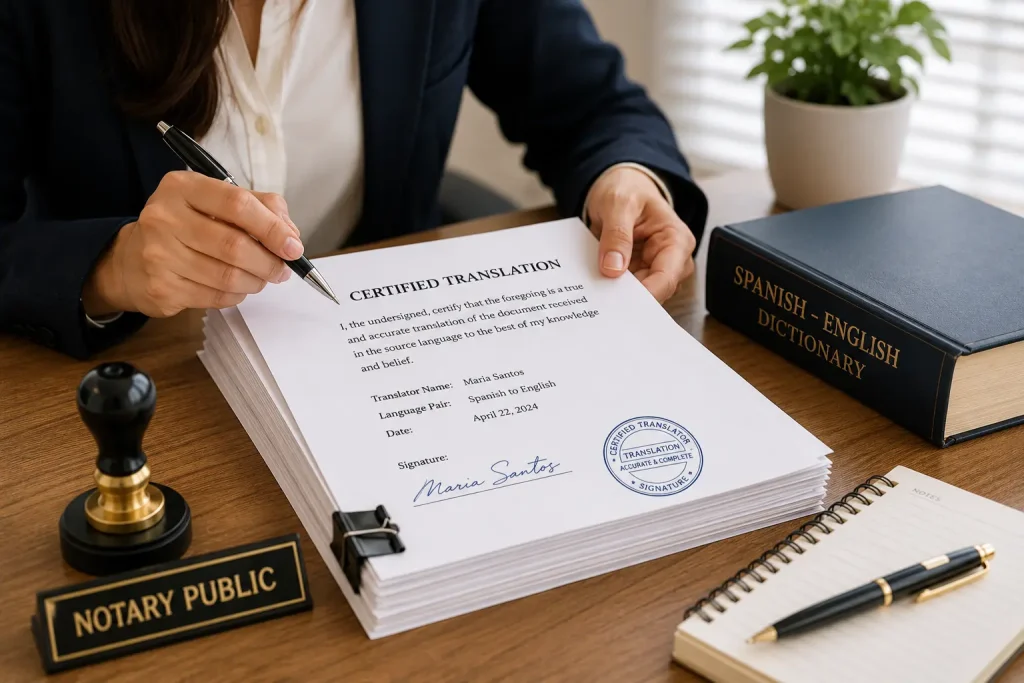
A certified translation is a professional translation accompanied by a signed statement confirming that the translation is complete and accurate.
Unlike a standard translation, certified translations are intended for official use. Government agencies, universities, employers, and foreign authorities frequently require them when documents are submitted in a language other than their own.
Examples include:
- Immigration applications
- Study abroad programs
- International employment
- Foreign court proceedings
- Dual citizenship applications
- Overseas marriages
- International business registrations
Even a minor translation error involving a name, date, or official seal can create delays or require documents to be resubmitted. For that reason, certified document translation should always be completed by qualified professionals familiar with official documentation.
Certified Translation vs. Notarized Translation vs. Sworn Translation
These terms are often confused, but they do not mean the same thing.
Certified Translation
A certified translation includes a signed certification stating that the translation is accurate and complete. This is the format commonly accepted by USCIS, educational institutions, and many government agencies.
Notarized Translation
A notarized translation generally means the translator signs a statement in front of a notary public. The notary verifies the identity of the signer—not the accuracy of the translation itself.
Sworn Translation
Certain countries require translations completed by officially appointed or court-authorized translators. These are commonly known as sworn translations and follow country-specific legal requirements.
Because terminology varies around the world, always confirm exactly what type of translation the receiving authority expects before ordering services.
Certified Translation Before Apostille: Which Comes First?
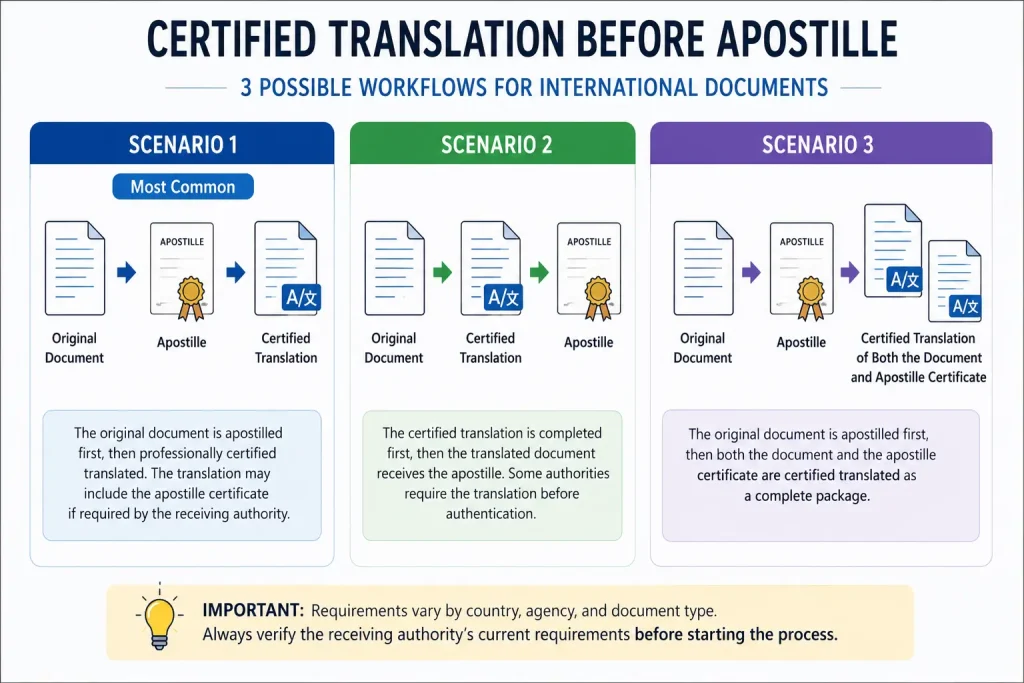
This is where many people become confused.
If you search online, you’ll find articles claiming the translation must always come first. Others insist the apostille should always come first.
Neither statement is universally correct.
The proper order depends on:
- The destination country
- The receiving authority
- The document type
- Local administrative procedures
- Whether the country participates in the Hague Apostille Convention
Scenario 1 (Most Common)
Original Document
↓
Apostille
↓
Certified Translation
This is the workflow many foreign authorities request because the translator can prepare a certified translation that reflects both the original document and, if required, the attached apostille certificate.
Scenario 2
Original Document
↓
Certified Translation
↓
Apostille
Some authorities require the document to be translated before authentication. This depends on their administrative procedures rather than a universal international rule.
Scenario 3
Original Document
↓
Apostille
↓
Certified Translation of Both the Original Document and the Apostille Certificate
Some governments request a complete translated packet that includes both the original document and the apostille certificate itself.
Pro Tip: Before paying for a certified translation or apostille, contact the receiving authority and ask for their current document requirements. A quick confirmation today can prevent expensive corrections later.
A Real-World Example
Imagine you’re moving overseas for work and need to submit your birth certificate.
A friend tells you they translated their birth certificate first because that worked for their visa application. You follow the same process, only to learn your employer requires the apostille to be attached before the translation is completed.
Now you may need to update the translation or, in some cases, have both the original document and the apostille certificate translated.
This is why relying on online forums or another person’s experience isn’t enough. The receiving authority determines the correct process, and their requirements may differ from another country’s or agency’s procedures.
Examples by Country
One of the biggest misconceptions about international document processing is that every country follows the same rules. In reality, requirements can vary not only by country but also by the government agency, university, employer, or court requesting your documents.
The table below provides general guidance. Always verify the latest requirements directly with the receiving authority before ordering an apostille or certified translation.
| Country | General Guidance |
|---|---|
| Spain | Requirements may vary depending on the government office or institution receiving the document. |
| Italy | Some authorities may request both the apostille and a certified translation. Verify before submitting documents. |
| Mexico | Processing requirements often differ by institution and document type. |
| Brazil | Translation and authentication requirements may vary depending on the intended use. |
| France | Certain agencies have specific document formatting and translation requirements. |
| Germany | Some authorities request certified translations prepared after the apostille is issued. |
| Colombia | Requirements vary depending on the document and receiving authority. |
Important: International document requirements change periodically. Always confirm the current process with the embassy, consulate, university, employer, court, or government agency requesting your documents.
Documents That Commonly Need Both an Apostille and a Certified Translation
Many official documents intended for international use require both authentication and translation. Some of the most common include:
- Birth Certificates
- Marriage Certificates
- Death Certificates
- Divorce Decrees
- Academic Diplomas
- School Transcripts
- Powers of Attorney
- Court Documents
- FBI Background Checks
- Articles of Incorporation
- Corporate Resolutions
- Business Agreements
Whether you’re applying for dual citizenship, enrolling in an overseas university, accepting a job abroad, or expanding your business internationally, preparing these documents correctly from the beginning can help prevent unnecessary delays.
Five Common Mistakes That Delay International Documents
International paperwork can be time-sensitive. Avoiding these common mistakes can save both time and money.
1. Choosing the Wrong Order
Many applicants assume every country follows the same process. Ordering a certified translation before the apostille – or vice versa – without confirming the requirements may result in duplicate work and additional costs.
2. Using a Translation That Doesn’t Meet Official Requirements
Not every translator provides certified translations suitable for government agencies or international institutions. Always verify that the translation meets the receiving authority’s standards.
3. Missing Required Notarization
Some documents must be notarized before they can qualify for apostille processing. Missing this step can delay the entire application.
4. Requesting the Wrong Apostille
Florida-issued documents generally require authentication through the Florida Department of State, while certain federal documents, such as many FBI background checks, require a federal apostille through the U.S. Department of State. Choosing the wrong process can add unnecessary time to your application.
5. Assuming Online Advice Applies to Your Situation
A process that worked for someone else may not work for you. Requirements often differ based on the receiving authority, document type, and destination country.
How iNotarizeServices Makes the Process Easier
International document preparation doesn’t have to be confusing.
At iNotarizeServices LLC, we help clients understand the document preparation process before paperwork is submitted for authentication or translation. While we do not provide legal advice, we carefully review your documents and explain the steps typically required based on the type of document and its intended international use.
Our services include:
- Certified Translation Services in more than 90 languages
- Florida Apostille Services
- Federal Apostille Services
- Mobile Notary Services
- Remote Online Notary (RON)
- Document Review and Preparation Assistance
Whether you need to authenticate a birth certificate, prepare a Power of Attorney, translate an academic transcript, or obtain a federal apostille for an FBI background check, our goal is to help you avoid unnecessary delays by ensuring your paperwork is prepared correctly from the start.
We proudly serve clients throughout Davenport, Polk County, Kissimmee, Orlando, ChampionsGate, Clermont, Lakeland, Winter Haven, and surrounding Central Florida, while also assisting clients across the United States through our remote and mail-in services.
Can I apostille a translated document?
It depends. Some jurisdictions allow certain translated documents to be authenticated, while others require the original document to receive the apostille first. Always verify the receiving authority’s requirements.
Do I need a certified translation before an apostille?
Not always. The correct order depends on the destination country, the receiving authority, and the type of document being submitted.
Does every country follow the same process?
No. Requirements vary by country and sometimes even by the specific organization requesting your documents.
Who provides certified translations?
Certified translations should be completed by qualified translators or professional translation providers who certify the accuracy and completeness of their work.
Can Florida issue an apostille for translated documents?
Eligibility depends on the document type, how it was prepared, and the applicable authentication requirements. Confirm the appropriate process before submission.
Ready to Prepare Your International Documents?
Whether you need Certified Translation Services, Florida Apostille Services, Federal Apostille Services, Mobile Notary, or Remote Online Notary (RON), iNotarizeServices LLC is here to help simplify the process.
Before spending money on translations or apostille services, let our experienced team review your documents and help you understand the appropriate next steps based on your destination country and document type. By preparing your paperwork correctly from the beginning, you can reduce delays, avoid unnecessary expenses, and move forward with confidence.
Contact iNotarizeServices LLC today to schedule your document review and receive trusted assistance throughout Davenport, Polk County, Kissimmee, Orlando, ChampionsGate, Clermont, Lakeland, Winter Haven, and Central Florida.
Important Disclaimer
This article is provided for informational purposes only and should not be considered legal advice. International document requirements vary by country, agency, and document type. Always verify current requirements with the receiving authority before submitting your documents.